Reflecting on the Archbishop’s Reflection
Lionel E. Deimel
July 31, 2009 (corrected August 4, 2009)
The recent reflection on the 76th General
Convention of The Episcopal Church by Archbishop of Canterbury Rowan
Williams has occasioned much commentary. “Communion, Covenant and our Anglican Future” (CCAF) provides an unusually clear
window into Williams’ thinking. That thinking seems to be changing as
events unfold, and much of it relies on assumptions not universally
shared within the Anglican Communion. CCAF reveals an archbishop
struggling to find his place at the front of the Anglican pack from
which to exert leadership. It remains to be seen whether he is laboring
to determine events largely beyond his control.
|
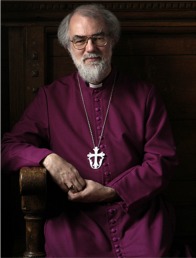
Archbishop of Canterbury
Rowan Williams |
Episcopalians need to take a very close look at CCAF to understand
better their problematic relationship to the Anglican Communion and
their possibly even more problematic Anglican future. They need to
recognize the ways in which the thinking of the Archbishop of Canterbury
and other Anglican leaders is dysfunctional or mistaken.
“Communion, Covenant
and our Anglican Future”
CCAF is divided into five numbered sections comprising 26 continuously
numbered paragraphs.
Section 1 (paragraphs 1–3) provides an introduction to the essay and is
the only section that refers explicitly to either The Episcopal Church
or to the General Convention. After acknowledging the General
Convention’s declaration of commitment to the Anglican Communion (in
D025, presumably), Williams declares that the work of General
Convention 2009 is unlikely to “allay anxieties” within the Communion
and that, under the circumstances, “two points … need to be reiterated
and thought through further.”
The first point is the subject of Section 2 (paragraphs 4–10). In this
section, the archbishop tackles arguments “against the moratoria
relating to same-sex unions.”
The second point is discussed in Section 3 (paragraphs 11–18), which,
along with the next, are the longest parts of CCAF. Section 3 deals with
the question of “how a local church (i.e., Anglican province) makes up
its mind on a sensitive and controversial matter.”
Having explicated the two points mentioned in the introduction, the
Archbishop moves on. Section 4 (paragraphs 19–25) discusses structural
options for the Anglican Communion. In particular, Williams picks up his
earlier idea of multiple types of Communion membership, preferring now
to talk about a “two-track” model, rather than a “two-tier” one.
Section 5 is a single paragraph (paragraph 26). It is, of course, a
wrapping up of the essay, but the writing here seems schizophrenic, as
though the archbishop is hedging his bets as to whether a fracture of
the Communion will be a part of the Anglican future. In any case, we
have, he asserts, “an opportunity for clarity, renewal and deeper
relation with one another.”
I now want to look at each of these sections in turn. I will not attempt
a complete analysis of CCAF, but I hope to point out problems with the
arguments we find in CCAF and elsewhere in discussions of the Anglican
Communion “crisis” and suggest other ways of looking at the mess the
Anglican Communion has gotten itself into.
The General Convention
There is little of substance in paragraphs 1–3, which are really just an
introduction to what follows. The Archbishop of Canterbury acknowledges
the hospitality and diligence of the General Convention, as well as its
stated commitment to the Anglican Communion and Anglican covenant
process. He acknowledges the signers of the Anaheim Statement. But the
Convention, he suggests, will not “repair the broken bridges into the
life of other Anglican provinces.” He then moves on, never again
mentioning The Episcopal Church by name.
LGBTs
Before addressing the substance of Section 2, I want to reiterate what
others have said about the language used in it. Williams thrice uses
“lifestyle” in connection with homosexual persons. In one instance, he
speaks of “their choice of lifestyle,” and, in another, he refers to “a
certain choice of lifestyle.” The archbishop is clearly out of touch
with the times; a promiscuous “homosexual lifestyle” was once assumed to
be universal among homosexuals, but it never was and isn’t now. Like
heterosexuals, homosexuals can choose to be promiscuous or monogamous;
there is no credible evidence that they can choose to be heterosexual
(or, for that matter, tall). Williams argues that “the issue is not
simply about civil liberties or human dignity.” After arguing, in
paragraph 5, that Anglicans should not be “reinforcing prejudice against
LGBT people,” however, he illustrates what such prejudice looks like in
his use of language in paragraphs 8 and 9. If the Archbishop of
Canterbury is thinking of gay bars and one-night stands, he is missing
the point of what The Episcopal Church has been saying all these years.
One fears that he is using code words to pander to certain members of
his audience.
Williams also seems to be targeting other anxieties as he frames what he
says is the issue, namely “whether the Church is free to recognise
same-sex unions by means of public blessings that are seen as being, at
the very least, analogous to Christian marriage.” At the very least?
For what else could anyone ask? (If a hypothetical gay marriage is indeed analogous to ordinary marriage, how much different from ordinary marriage could it be?) Anyway, Williams goes on to argue that
the Church has had the same view of marriage for 2,000 years—a dubious
proposition—and that a great deal of theology would be needed to change
that view.
The archbishop then conflates the issues of same-sex blessings and
partnered gay clergy—surely these are separable, if related,
issues—arguing that, since the church does not sanction the “chosen
lifestyle” of such a person, that person cannot “act in the necessarily
representative role that the ordained ministry, especially the
episcopate, requires.”
Admittedly, there is some logic to the notion that churches should
approve gay unions before consecrating partnered gay bishops, but there
is also something disconcerting about the “representative role” argument
in CCAF . It sounds a lot like the argument that women cannot be priests
because they lack penises, an argument that much of the Anglican
Communion—perhaps not enough of it—has rejected. (By a similar argument,
a priest cannot be Japanese, since neither Jesus nor any of his apostles
were Japanese.) This argument makes no sense, of course, once a church
has accepted same-sex unions. The Episcopal Church has effectively done
this and has done the theology justifying it. The Anglican Communion has
not.
I want to return for a moment to that “analogous to Christian marriage”
remark, which is clearly intended to raise the stakes in the LGBT
debate. No doubt, the archbishop subscribes to the view that the
marriage bond is holy in the same sense that Christ’s relationship to
the Church is holy. This is a lovely thought when you are standing at
the front of the church before a priest and next to your intended. I
have never found the logic of investing so much significance in marriage
to be compelling, however, and I therefore see less at stake in
arguments over same-sex unions as some do.
The early Church used marriage as a model for the relationship of Christ
to his Church. Analogies are like this—we use something we understand to
explain something we understand less well, saying that the second thing
is, in some way, like the first. But we cannot blithely run the logic
the other way. We cannot really say that marriage is like the
relationship of Christ to his Church. This does not explain marriage; it
merely mystifies it. Moreover, the analogy is useless if we fail to
specify in what respect the relationship of Christ to his Church
is like that of husband to wife. The similarity, I suggest has nothing
to do with sex or complementary organs of reproduction. Instead, I think
the husband-wife relationship is like the Christ-Church relationship in
that they both are loving, caring, self-sacrificing, and exclusive
relationships. One could make an analogous and equally true statement
substituting committed gay partners for the husband and wife.
All this is not to dismiss the importance of marriage, but things have
to be kept in perspective. In a church that allows divorce, one should
not press the marriage-like-Christ-and-his-Church idea too far.
Making Decisions
In Section 3, Williams deals with “the broader [issue] of how a local
church makes up its mind on a sensitive and controversial matter.”
Recall that “local church” refers to an Anglican province. The
archbishop is surely thinking of The Episcopal Church here.
The basic message in this section has become familiar: “what affects the
communion of all should be decided by all.” The archbishop admits, at
least implicitly, that “what affects the communion of all” is a judgment
call and that, in the history of the Church, “wider discernment has been
very fallible.” He nevertheless believes that a local church cannot be
trusted to make important decisions on its own. (Note that purveyors of
autonomy with interdependence are talking about selective autonomy, at
best.)
The archbishop finds two kinds of problems with local decision-making on
important issues. First, other provinces will find the innovator
“unrecognisable” and “strange.” A hallmark of Anglicanism has been its
tolerance of theological diversity, however, and it is tiresome to be
called a non-Christian whenever a conservative “Anglican” disagrees with
me. Again, matters have to be kept in perspective, and, however
important sex may be to humanity, the Church does have more important
concerns. In any case, I suspect that, were I to inquire into the
matter, I would find practices in other Anglican provinces that seem
strange and unrecognizable to me and to other Episcopalians.
Williams’ second problem is that, in ecumenical discussions, other
churches will want to know who speaks for the Communion, and having one
province out-of-step is confusing. I fail to see much of a problem here,
either. In the case of partnered, openly gay bishops, for example, it is
clear that The Episcopal Church is not, in principle, against them. It
is just as clear that some other churches are, though they may have no
scruples about consecrating partnered, closeted gay bishops. It is not
even clear to me that the Anglican Communion, per se , should be trying
to make agreements touching on doctrine with other churches, as the
provinces have no obligation to be in any way bound by such agreements.
(Besides, we have enough trouble agreeing among ourselves. Isn’t this
what we’re struggling with now?) The Episcopal Church, for
example, is perfectly capable of making practical agreements with other
churches, such as the Evangelical Lutheran Church in America or the
Moravians. Frankly, I find some of the pronouncements coming from the
Anglican-Roman Catholic International Commission (ARCIC) unrecognizable
and strange.
The big problem I have with the archbishop’s thinking is that he finds
intrinsic virtue in agreement. He would rather the entire communion be
wrong together than risk the possibility that an individual province
might be wrong on a given issue. The archbishop has apparently never
heard of risk assessment. If The Episcopal Church is making bad
decisions, it will, led by the Holy Spirit, eventually correct them.
Meanwhile, there is no objective reason the rest of the Communion cannot
continue on its present path. If, on the other hand, The Episcopal
Church is trying to do God’s will, but is prevented from acting until a
Communion consensus develops—need I point out that this won’t happen in
our lifetimes?—LGBT members of The Episcopal Church will be harmed, and
LGBT Anglicans elsewhere in the world will have to wait even longer to
find their proper place in their churches. More likely, they will simply
desert Anglicanism completely. I can, with near certainty, predict that
LGBT persons will, throughout the Communion, eventually be treated like
everyone else. I think the archbishop risks making a minor mistake in
failing to constrain The Episcopal Church and risks committing a
colossal blunder if he does.
In the past, the Christian Church has considered it just fine if it
takes a few centuries to reach a correct conclusion or if it kills a few
innocents along the way. In this fast-paced, communication-intensive
twenty-first century, the Church no longer has that luxury. Better that
the Church make decisions more quickly, even if some prove to be wrong,
than that it risk being widely dismissed as irrelevant.
Communion Structure
Section 4 of CCAF, raising as it does the possibility of moving to a
“two-track” Anglican Communion, has received the most attention in the
media. To that, we now turn.
From the vantage point of a latecomer to The Episcopal Church who sat
through a thorough inquirer’s class before being confirmed some 25 year
ago, the archbishop begins this section badly. He assumes that the
Anglican Communion is and should be hierarchical and tightly bound
together. He portrays this as the “self-understanding of our Communion,”
particularly in the last half-century. I was taught, however, that
Anglican provinces are autonomous, that the Lambeth Conference is just
for discussion and without legislative function, and that the Archbishop
of Canterbury is the “spiritual head” of the Communion but without any
real power.
In fact, what Williams and other primates have been doing is portraying
themselves as conservatives, preservers of the Anglican status quo. In
reality, they are revolutionaries, trying to hoodwink the naïve and the
over-courteous into abandoning the fellowship that has been the Anglican
Communion in favor of a radical centralization intended to enforce
doctrinal uniformity. This is the underlying purpose of the Anglican
covenant. Terms such as “mutual responsibility” are thrown about by the
archbishop as a kind of spiritual blackmail intended to intimidate
churches such as our own into giving up their birthright of
ecclesiastical autonomy. Williams derisively dismisses “mere federation”
as though it were not what the Communion has been these many years.
Yes, the Communion has developed more central structures, beginning in
the second half of the twentieth century. But consider our so called
“Instruments of Unity” (or “Communion,” or whatever). Let us begin with
the Archbishop of Canterbury himself. It has been easy for The Episcopal
Church to acknowledge him as the spiritual head of the Communion, as he
has traditionally lacked any real power over Anglican churches.
Otherwise, why would an American church, a church in a country that
fought a bloody war to separate from England, kowtow to an archbishop we
have no part in selecting and who is technically a part of the British
government?
Then there is the Lambeth Conference. When it began nearly a century and
a half ago, it was made very clear that it was not intended as an
Anglican synod. Yet, many years later, Lambeth 1998 I.10 is touted as the “teaching of the Communion.” What
is the authority of such a resolution, made by this international
gathering without consulting laypeople, deacons, or priests? Neither the
Lambeth Conference nor, for that matter, the Archbishop of Canterbury,
is mentioned in the constitution or canons of The Episcopal Church. They
have no official connection to our church. Episcopal bishops are not
authorized to represent the membership or leadership of The Episcopal
Church at Lambeth, and nothing binds our church or its members to its
actions. Resolutions of the Lambeth Conference are merely the
declarations of a collection of bishops who have been given
all-expenses-paid trips to England.
The name of the Anglican Consultative Council is surely suggestive: it
is a body for consultation, not for authoritative legislation. It
is at least notable for including laypeople, deacons, and priests; outside
of the United States, Anglican churches are much too dominated by
bishops, at least from the American democratic perspective.
Then there is the latest Instrument, the Primates’ Meeting. This
institution was created to provide an opportunity for “leisurely
thought, prayer and deep consultation” among the primates of Anglican
provinces. Notice again that word consultation. Alas, this
institution has become the source of infinite mischief in the Communion.
Of course, the Primates’ Meeting has no standing in our constitution and
canons, either. It has no authority over us, and, given its short
history of mischief-making, should never be given any such power.
What Archbishop Williams is doing is Section 4 is again trying to sell
his Anglican covenant idea, which he is promoting as the only solution
to address the “risks and confusions” present in the Communion. (I would
argue that an Anglican covenant is the only solution because the
archbishop will not allow any other solution to be considered.) The
covenant is necessary, we are told, if we are to “intensify existing
relationships.” This phrase, apparently a product of the 2008 Lambeth
Conference, means something like everyone’s messing in everyone else’s
business. Perhaps we do not want to intensify existing
relationships.
The reality, however, is that the actions of the General Convention have
made the archbishop nervous. He is promoting a covenant, and he is
worried that The Episcopal Church, and perhaps other churches,
ultimately will reject it. Even in the face of that eventuality,
Williams wants to keep everyone, in some sense, at the table. (I suspect
that this is mostly about making sure The Episcopal Church continues to
contribute a substantial fraction of the funds necessary to maintain the
Communion infrastructure, but this view may be unduly cynical.) In no
case, declares Williams, will any province be “cast into outer
darkness.” (Actually, I rather doubt that that is the image that many
Episcopalians have of their church’s not being in the Anglican
Communion. I personally am beginning to think of it more as being
released from the asylum, but my cynicism may be asserting itself
again.)
If the worst happens, there could be, the archbishop suggests, “a
twofold ecclesial reality”—a covenanted Anglican Communion and a
related, more loosely connected Anglican Communion (i.e., what we
thought we have had all these years). Williams had raised the specter of
such a dual-class communion some time ago. Doing so then was, I think,
something of a scare tactic. Now, however, seeing rejection of a
covenant as a serious possibility, he is trying to make the idea of an
un-covenanted Communion seem more palatable. He now speaks of a
“two-track” model, language that tries to avoid the first- and
second-class implication of “two-tier.” There could be, we are told,
“two styles of being Anglican.” Clearly, the Archbishop of Canterbury
wants there to be only one style of being Anglican, and that is not the
one that was explained to me in inquirer’s class.
Williams ends Section 4 by raising some especially disturbing issues. In
paragraph 24, he writes: “It should not need to be said that a
competitive hostility between the two [tracks, tiers, or whatever] would
be one of the worst possible outcomes, and needs to be clearly
repudiated.” I take this to be a subtle suggestion that, if The
Episcopal Church does not sign on to the Anglican covenant, Robert
Duncan’s Anglican Church in North America could, and could be recognized
as an Anglican province competing for souls in the U.S. and elsewhere.
Our church should not worry about this, and has only alienation of
property, not parishioner poaching, to fear from ACNA.
But Williams has one more threat to make. A “clear answer,” he said, is
needed to the question of whether, if a province rejects the covenant,
“elements” of the province (read “dioceses”) will be free to sign on to
the covenant on their own. The answer, of course—I can give the
archbishop total clarity here as far as The Episcopal Church is
concerned—no, any more than Pennsylvania can negotiate a treaty with
Sweden. It is beyond comprehension that the archbishop would raise this
issue after pointing out “the explicit provision that the Covenant does
not purport to alter the Constitution or internal polity of any
province.” Does this man think he can reformulate the Communion as a
collection of individual dioceses under his own authority, simply
bypassing the provinces? What would a diocese’s signing on to the
covenant mean, and how would diocesan loyalties be divided between the
Communion and the “local church”? If Williams thinks this is a
possibility, he should ask himself how the dioceses of the Church of
England might choose to align themselves.
A point needs to be made here about innovation in human communities.
(Rowan Williams does admit that the understanding of the church can
change over time. Mercifully, he is not in the habit of speaking of
preserving “the faith once delivered to the saints.”) Innovation does
not usually come about by waiting for everyone to come around to the
view that the conventional way of doing things is wrong. Change can
come about this way, but, if it does, it tends to happen very slowly.
More often, successful innovation begins with a person or group of
people breaking out of the mold—doing something unprecedented, perhaps
even illegal. (The American Revolution, Civil Rights Movement, and
irregular Philadelphia ordinations of women come to mind.) If the
Anglican Communion is not to become a relic, it is going to have to
learn to put up with real innovation and to live with the resulting
discomfort, perhaps even with missteps.
Wrapping It Up
Section 5 seems intended as a hopeful conclusion to the Archbishop’s
reflection. He is, I think hoping for the best, while suggesting that we
will somehow survive a split without really splitting, if it comes to
that.
Here, Williams tells us that we face “an opportunity for clarity,” an
odd inducement for the adherents of Anglicanism, which has survived for
nearly 500 years by choosing ambiguity over clarity. Clarity creates
winners and losers, and the biggest loser is always unity, which, in
traditional Anglicanism, has been about praying together, rather than
agreeing on doctrine. According to the archbishop, however, “we have
(remarkably) contained diverse convictions more or less within a unified
structure.” What he does not say is that our Anglican failures have
often involved inflexibility. Think English Civil War or the loss of the
Methodists.
There is some reason to view “Communion, Covenant and our Anglican
Future” hopefully. Archbishop of Canterbury Rowan Williams is showing
some signs of flexibility. The threat of two classes of membership
within the Anglican Communion has become, in its latest incarnation, a
possible solution to a seemingly intractable problem. As long as the
archbishop and other Anglican leaders insist on “clarity,” however, that
is, on creating winners and losers, the goal of keeping the Anglican
Communion together will be elusive. In any case, with the GAFCON crowd
hinting that it is time to remove Canterbury from its central place in
the Anglican universe, it is perhaps time for the archbishop to be
exploring additional options.
|



