|
|
A Matter of Mottos
|
| A
version of this essay appeared on my blog on November 13, 2011.
I decided to revise it and put it here because what I had to say seems
as relevant in 2016 as the did in 2011, and because my remarks are offered
in the same spirit as those of my earlier essay
on the Pledge of Allegiance. In a sense, “A Matter of Mottos” and
“The Pledge of Allegiance Revisited” are companion pieces, treating
issues of church and state that receive too little attention. — LED, 4/23/2016 |
| In November of 2011, the House of Representatives voted overwhelmingly to reaffirm “In God we trust” as the official motto of the United States. Of course, the motto was not about to expire, so the vote and the half-hour discussion that preceded it were a waste of time. Recently, however, President Obama had mistakenly identified “E pluribus unum” as the nation’s motto in a speech, and the Republicans saw an opportunity to embarrass the leader for whom they had such utter contempt. That the president himself seems to have been confused about the nation’s motto suggests that it might be worthwhile to inquire into why there might be confusion and whether the nation’s official motto is well chosen. Actually, “In God we trust” and “E pluribus unum” seem to represent two views of America competing for ascendency. History“E pluribus unum,” usually translated “out of many, one,” is one of three Latin phrases on the Great Seal of the United States, which was adopted by Congress in 1782. (The other two are “Annuit cœptis”1 and “Novus ordo seclorum.”2) Though prominent on our currency and elsewhere for more than two centuries, the phrase, “E pluribus unum” was never officially designated the motto of the United States of America. “In God we trust” first appeared on U.S. coins in 1864, during the Civil War.
This was done on the recommended of Lincoln’s Secretary of the Treasury, Salmon
P. Chase. Presumably, the addition to U.S. coinage was intended to
associate God more closely with the Union cause. In 1956, during the Cold War against “godless Communism,”
“In God we trust”
was declared by Congress to be the official national motto. The next
year, it was added to paper currency. This was the same period during
which the words “under God” were added to the Pledge of Allegiance,
thereby distinguishing our country from our Cold War rival, the Soviet Union.
(See “The Pledge of
Allegiance Revisited” and “Out
of Many, One.”)
“In God we trust” first appeared on U.S. coins in 1864, during the Civil War.
This was done on the recommended of Lincoln’s Secretary of the Treasury, Salmon
P. Chase. Presumably, the addition to U.S. coinage was intended to
associate God more closely with the Union cause. In 1956, during the Cold War against “godless Communism,”
“In God we trust”
was declared by Congress to be the official national motto. The next
year, it was added to paper currency. This was the same period during
which the words “under God” were added to the Pledge of Allegiance,
thereby distinguishing our country from our Cold War rival, the Soviet Union.
(See “The Pledge of
Allegiance Revisited” and “Out
of Many, One.”)In 2006, the Senate, celebrating the 50th anniversary of “In God we trust” having been declared our motto, passed a resolution reaffirming the choice. The 2011 action by the House of Representatives was, of course, simply celebrating the raw political power of the Republican Party and its Tea Party wing. 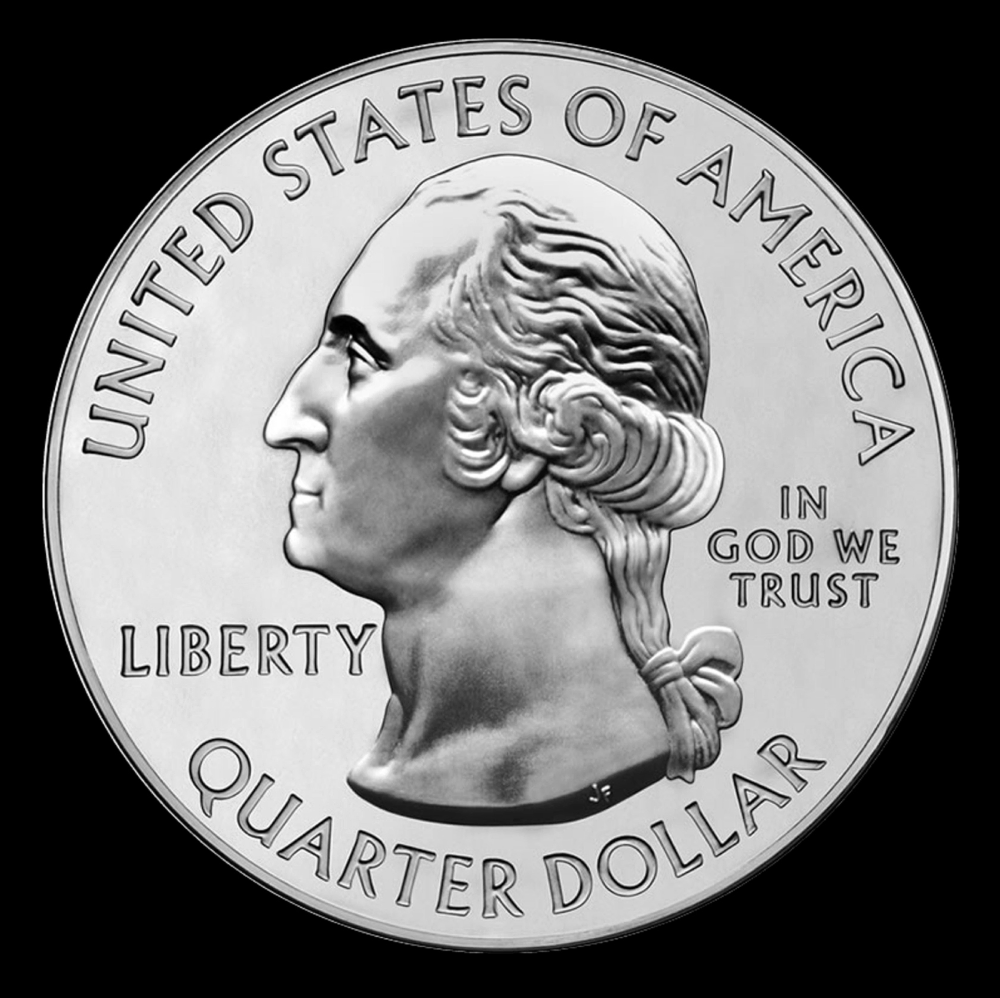 That said, the House vote was not especially partisan. The resolution
was carried by a 396–9 majority, with two members voting “present.”
Even in what is supposed to be a secular state, seeming to vote against God is
tough to do. A single Republican did so. That said, the House vote was not especially partisan. The resolution
was carried by a 396–9 majority, with two members voting “present.”
Even in what is supposed to be a secular state, seeming to vote against God is
tough to do. A single Republican did so.One might think that having a transparently religious motto would be a violation of the First Amendment’s prohibition of laws respecting “an establishment of religion,” but the Supreme Court has allowed the invocation of God in the public square as innocuous instances of “ceremonial deism,” a term coined by the late Yale Law School dean, Eugene Rostow. Judges are as reluctant to vote against God as are legislators. A Tale of Two MottosIn principle, a motto should say something important about its adopter. It can articulate a guiding principle, emphasize an important characteristic, or proclaim an aspiration. Selecting a motto for a nation is a particularly daunting task, as even harmonious and homogeneous populations are complex communities not easily or concisely characterized. Mottos are not essays, so the need for brevity limits possible options.Curiously, neither “E pluribus unum”
nor “In God we trust” alludes to such concepts as liberty, freedom,
or democracy, any one of which might be considered an essential element
of the American experiment. Thus, “E pluribus unum” fairly characterizes both the nation’s political organization and its population. Significantly, there is no such thing as native American stock—even “native Americans” are not intrinsically American, since being American is not an ethnicity, but a state of mind. We become Americans by leaving our ethnicity behind and becoming something new—a new one. The American nation truly is—to borrow another phrase from the Great Seal—“Novus ordo seclorum,” a new order of the ages. “In God we trust,” on the other hand, is rather non-specific. It could
equally be applied—some might say would be better applied—to Saudi
Arabia, Pakistan, Iran, Israel, or the Vatican. In fact, its Spanish
equivalent, “En Dios Confiamos,” is actually the motto of Nicaragua,
a coincidence many Americans might find disconcerting. The Fight for the Nation’s SoulAdmittedly, revisiting the motto of the United States is neither a burning political issue nor one destined to figure in the 2016 presidential race. The apparent consensus of the House of Representatives notwithstanding, however, “In God we trust” and “E pluribus unum” can be seen as representing very different views of the country whose partisans are vying for the nation’s soul.In the minds of those fondest of it, “In God we trust” does not now, nor has it ever, referred to an abstract God of ceremonial deism. It refers instead to the Christian God and reflects their unshakable, if mistaken, belief that the United States of America was founded as, and continues to be, a “Christian” nation. For these people, “In God we trust” is a perfect motto for a country whose laws should reflect “Christian” values—their values—and should provide them special rights, such as the right to discriminate against people they hold in disrepute.4 Those who insist that ours is a Christian country are not only historically ignorant but also misunderstand the whole American system. For them, politics is not the art of the possible, not a process of give-and-take among competing interests, but a winner-take-all contest of good versus evil. Alas, all too easily does “In God we trust” become “God’s will, as we understand it, must prevail over those of our fellow citizens.” “In God we trust” justifies banning abortion and gay marriage, limiting speech and immigration, teaching creation “science” and not evolution, and insisting on state sovereignty whenever the federal government gets something “wrong.” In practice, “In God we trust” is not about “we” at all, unless “we” refers to those adhering to a narrow, conservative brand of Christianity. Alas, many of the take-no-prisoners attitudes of the Christian
right have infected conservatives generally, especially conservative
Republicans. Ironically, those most angry about the ineffectualness
of government are those most responsible for it. These are the ideas now contending for supremacy in the Republic. Whatever our formal motto, I pray that it will be the spirit of “E pluribus unum” that guides our nation into the future. ____________________1Literally, the phrase translates to something like “has favored our undertakings.” The subject is only implied. “God” is often asserted to be the subject, but “Providence” is a more logical choice, as the Eye of Providence appears on the seal above the unfinished 13-course pyramid. Notice that—fortuitously or by design—both “Annuit cœptis” and “E pluribus unum” contain exactly 13 letters. (“In God we trust” contains only 12 letters.) 2This translates to “a new order of the ages.” 3I suspect that many citizens would consider any non-English motto too elitist for their taste. A Greek motto, alluding to an earlier democracy, might seem appropriate, though a motto in a foreign alphabet would seem even more pompous. 4Such attitudes are not held by all Christians, of course, and they are rare among mainline, as opposed to evangelical, Christians. 5The Religious Freedom Restoration Act (RFRA) and its state analogues have now privileged alleged religious rights over other freedoms. There were legitimate reasons for passing RFRA, but, with cases such as Burwell v. Hobby Lobby, “religious freedom” has gotten out of hand. |


|
|
