|
|
Our National Anthem
|
|
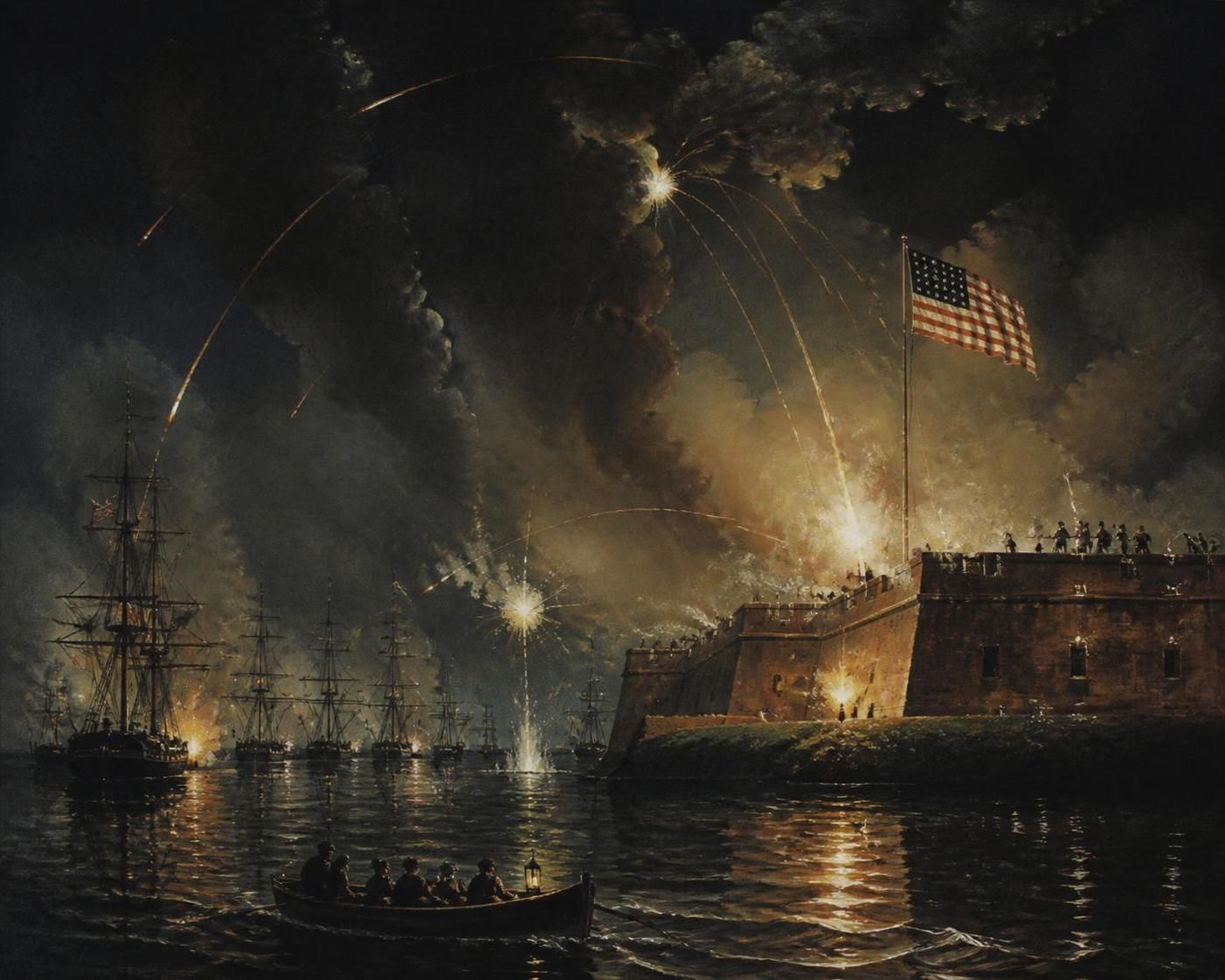
As we approach the nation’s 250th anniversary, I began thinking about our many national songs—“America,” “God Bless America,” “Columbia, the Gem of the Ocean,” “America the Beautiful,” “Hail, Columbia,” “This Land Is Your Land,” etc., and the song that became our national anthem, “The Star-Spangled Banner.” have always been fascinated by “The Star-Spangled Banner.” We all know the anthem, but I suspect most of us have not thought deeply about it. The lyrics contain possibly unfamiliar words and convoluted syntax. (I always liked diagramming sentences and once tried to diagram its first sentence. Good luck trying to reproduce that feat!) Many citizens, I suspect, would be hard-pressed to describe exactly what the lyrics are about, much less explain the event that inspired them. Francis Scott Key, who wrote the poem originally called “Defence of Fort M’Henry,” was on a diplomatic mission to the British fleet that was attempting to take Baltimore during the War of 1812. From an American “truce ship” on September 13 and 14, 1814, Key viewed the bombardment of Fort McHenry, which was defending Baltimore Harbor. When he saw the stars and stripes flying over the fort on the morning of September 14, he was inspired to write the words that became our national anthem. Key chose the tune, “To Anacreon in Heaven,” to which we sing Key’s poem. “The Star-Spangled Banner” became our official national anthem by a 1931 act of Congress. Many have criticized our anthem. Perhaps the most frequently heard complaint is that the song is too difficult to sing. (Its rendition at sporting events is often cringe-inducing.) It is sometimes accused of being too bellicose. Other national songs have been advanced as our national anthem for various reasons. One has to acknowledge that our anthem is not easy to sing. The music does have a certain majesty, however, and I think it makes a good impression at the Olympics after one of our athletes has won gold. The criticism that the anthem is too militaristic is somewhat unfair. It celebrates a military victory—in the first verse, anyway, which is the only one that is usually sung—though it does so in a particularly un-military sort of way. Significantly, the tune is not a military march, being written in 3/4 time. “America the Beautiful” is often mentioned as a “better” anthem. But the beauty of America is irrelevant; its essence lies elsewhere. Besides, the emphasis on the landscape seems too close to the blood and soil obsession of Nazism. “This Land Is Your Land” not only emphasizes the landscape but also has communist overtones. “God Bless America” is too religious for a secular United States. “America” (“My Country, ’Tis of Thee”) would be a better choice than most, as long as one avoids the reference to God in the final verse. And who remembers “Columbia, the Gem of the Ocean” or “Hail, Columbia”? It is difficult to capture the essence of a nation in a single song. Most national songs emphasize only one or two characteristics. (The Seekers offered a laundry-list strategy of national song composition in their quite wonderful song “I Am Australian.” But Australia’s actual anthem is “Advance Australia Fair.” Many thought “Waltzing Matilda” would have been a better choice. But I digress.) As an entry to an Independence Day contest, I wrote an anthem that attempted to be more comprehensive than most. You can find “Out of Many, One” here. Obviously, my anthem has not achieved fame. But what about “The Star-Spangled Banner”? The lyrics of Francis Scott Key focus on the flag, only a symbol of the nation, and on a specific historic event. This doesn’t seem promising for a national anthem; “The Star-Spangled Banner” hardly answers the question: What is America? (or what does it mean to be an American?). To those who object to the anthem’s “militarism,” I will point out that it is a defensive action that was Key’s inspiration. “The Star-Spangled Banner” celebrates not military aggressiveness but national resilience, arguably a very American virtue. And like most national songs, it celebrates freedom and bravery. Is “The Star-Spangled Banner” a perfect national anthem? Surely not. But it is a reasonable anthem, and there is no pressing reason to replace it.
— LED, 6/8/2026 |


|
|