Nested Parabolas
I asked myself what it would look like if parabolas were drawn on the
backs of one another. I imagined something like the following:
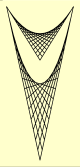
Clearly, the arms of a second parabola would need to
be longer than those of the first. How short could these arms be if the two
parabolas intersect only at their endpoints? With some simplifying assumptions,
we can answer this question.
Assume the center point of a parabola is at the
origin, and the endpoints are at A = (-w, d) and B = (w, d).
Thus, we can draw a parabola with arms of equal length. (Think of d as
the depth of the parabola and 2w as its width.) We want to
draw a second parabola with the same endpoints and a center point at B = (0, x),
where x is negative. The construction needs to be such that none of the
lines of the parabola cross the y-axis above the origin, where such a line would
intersect the center point of the first parabola.
It is easy to see that, if a parabola is drawn using
the arms AB and BC, the line of the parabola that intersects the y-axis as high
as possible will be the line connecting the midpoints of AB and BC. We can
minimize x by having the line intersect the origin, that is, the center
point of the original parabola. To connect these points
|x| must be equal to d. (Whether the
lower parabola contains a horizontal line connecting the midpoints of its arms
depends on whether the number of divisions on the arms is odd or even.)
Generalizing the size of the
nth parabola is less straightforward. The logic is basically
the same, the depth of the second parabola is twice that of the previous
parabola. Therefore, the center point of the next parabola is at (0, 4d). The
center point of the nth parabola is at (0, ‑(dn)).
With that out of the way, we
can begin to create some figures. Here is a sample combining four parabolas:

Some observations:
- The size of the figure grows quickly as
parabolas are added.
- Increasing d increases the size of the
figure.
- If the arms of each parabola are divided into
the same number of segments, the length of the segments increases with each
parabola added. (We will return to this phenomena below.)
The first “interesting” construction I developed put
two parabola nests back-to-back:
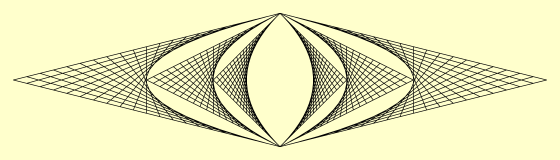
My design became more interesting when I combined
them with (invisible) polygons. Here is an example:

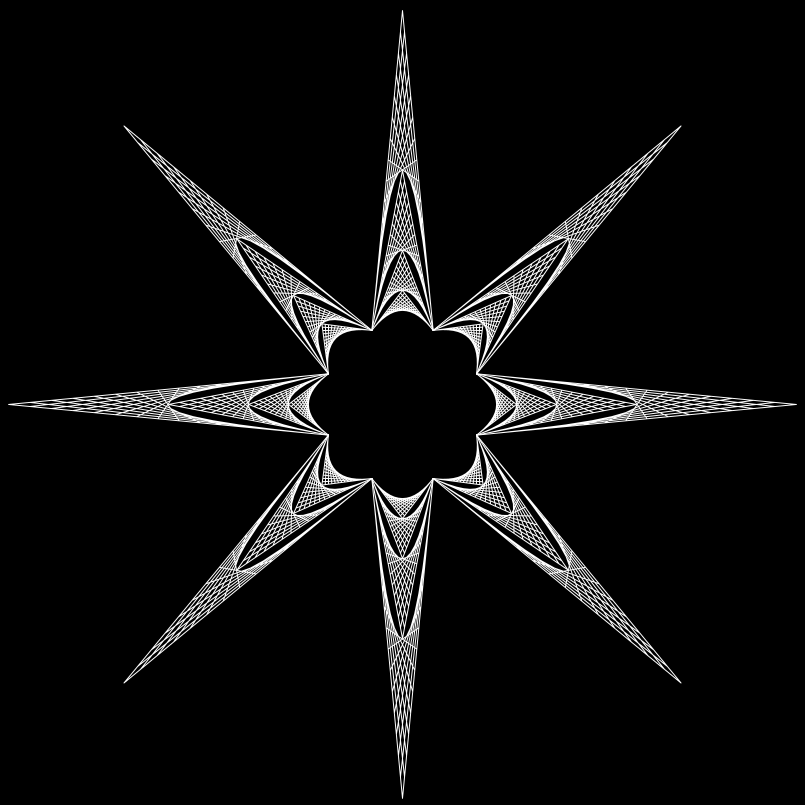
We can manipulate the number of nested parabolas,
the number of segments into which parabola arms are divided, the number of sides
of the polygon, and the width and depth of the parabolas. Here is an example in which all
of those parameters are modified:
Here is another design:

Notice that the lines of the innermost parabola are
denser than those of the outermost parabola. We can, if we like, maintain the
same or nearly the same spacing of arm segments. This works out well in some
cases, as in this design:
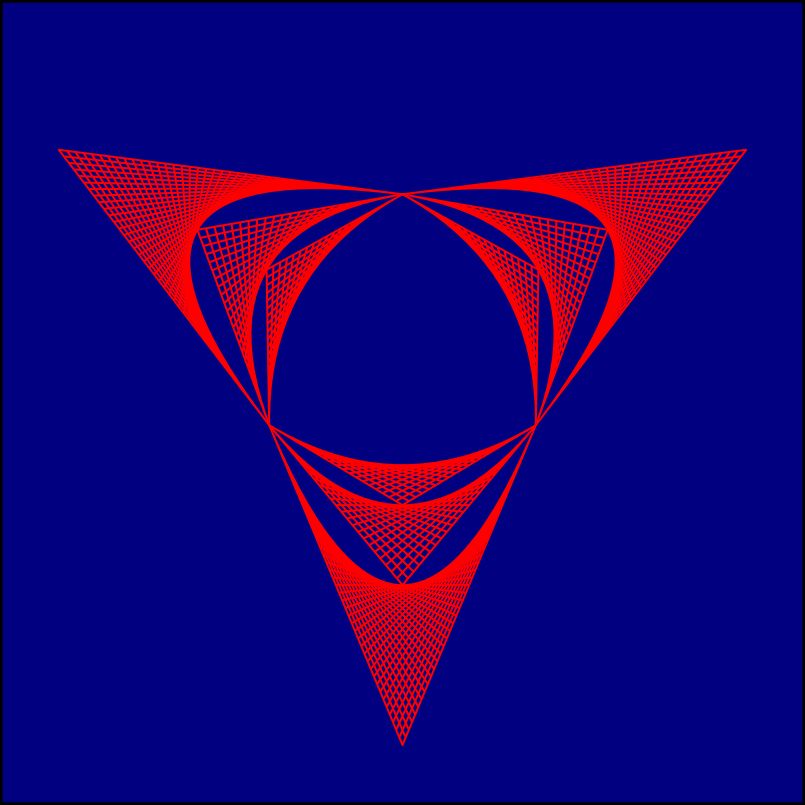
Adjusting the segments to be of equal length
everywhere may or may not seem a good choice because later parabolas seem
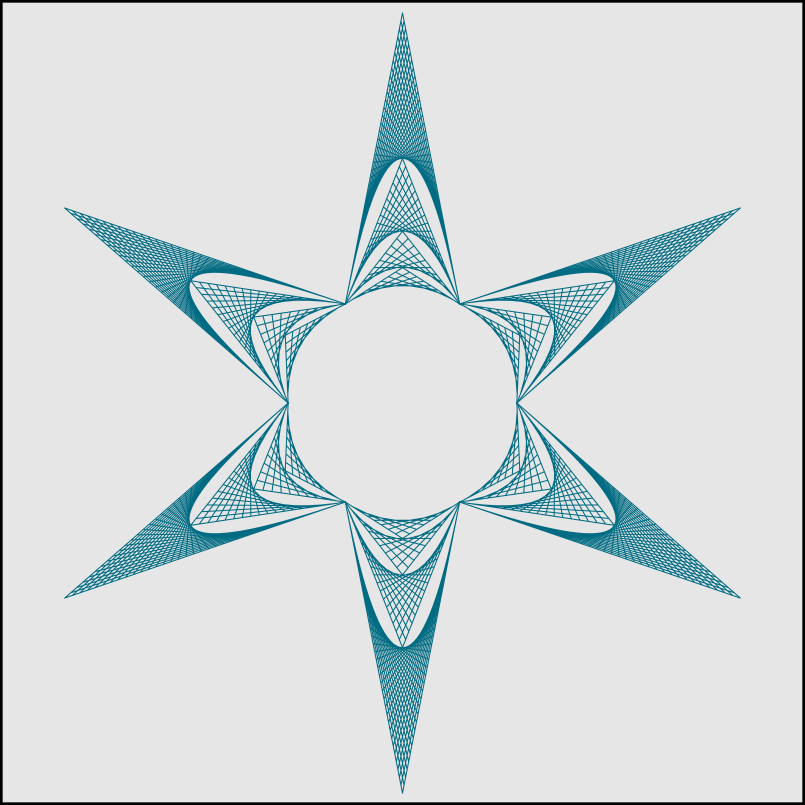
much denser than earlier ones. Here is another figure in which the segment
lengths have been homologized. Decide for yourself how well this works in the figure:
Rather than keeping all segments the same length,
one could make adjustments that made spacing seem uniform without
actually being uniform. I have not experimented with this idea.
Perhaps other sorts of figures could be made with
nests of parabolas as shown above. I leave it to others to discover such
designs.
— LED, 8/2/2024 |



